
News
Are Bicycles Medical Devices?
•
- In Part III of our series Put Your Phone Down and Go Ride we bike the Foothills National Recreation Trail with Cycling Over Sixty founder Tom Butler.
- Butler believes bicycling is medicine and trails are crucial infrastructure for more people to safely pedal for health.

Paul Tolmé

Bicycling is a healthy activity, but are bikes medical devices?
Cascade member and Cycling Over Sixty podcaster Tom Butler thinks so.
Four years ago, following several decades of inactivity, Butler took up bicycling to treat his type 2 diabetes and get in shape. It worked.
He lost 30 pounds, improved his health and wellbeing, and has become a full-time bike advocate working to get more older people out riding for physical and mental health–and social connection.
Butler is a proponent of Exercise is Medicine, a global health initiative of the American Medical Association and the American College of Sports Medicine. Exercise is Medicine stipulates that physical activity is essential for health and the prevention and treatment of chronic illnesses including diabetes.
Bicycling is special among the many forms of exercise because it’s social, accessible, and takes people outside to explore the natural world.
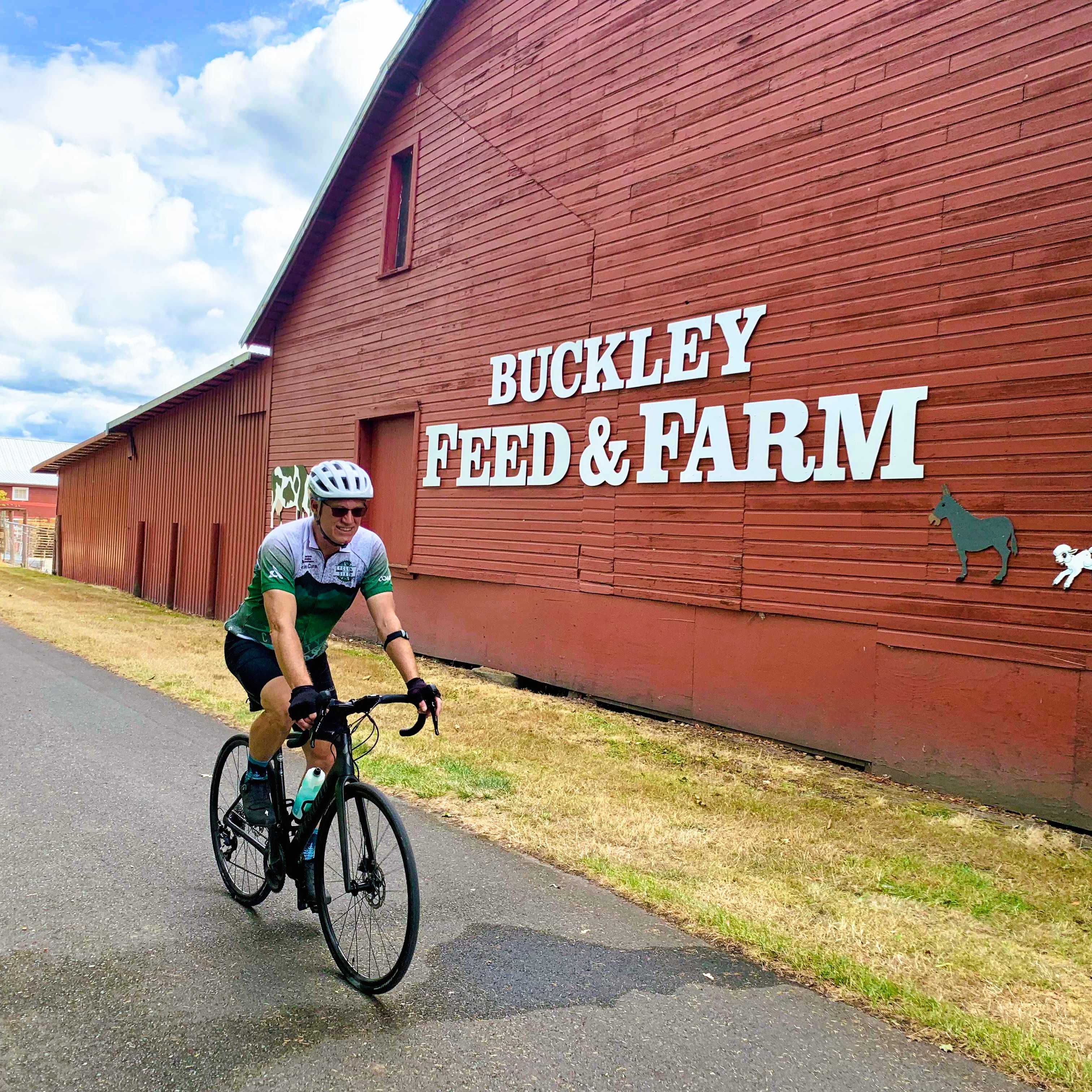
“Being outdoors on a bike is fun, and that fun factor may be the single most important element of the bike as a medical device,” Butler says. “Because health outcomes depend on consistency, and people stick with what’s fun.”
Put Your Phone Down and Go Ride!
This is the third installment in our series “Put Your Phone Down and Go Ride,” which encourages people to reduce the amount of unhealthy “ultraprocessed time” they spend staring at screens. Sedentary lifestyles and too much time indoors on devices have disconnected us from the joys of the natural world and the healing powers of socializing.
Nearly 60 percent of Americans say they use their phone too much. At the same time, only a fifth of us get enough exercise and more than half of American adults get fewer than five hours weekly outside in nature.
In our previous story we spotlighted some of our favorite paved and unpaved trails for summer cycling. In this third installment we take a spin with Butler to learn about the medical benefits of bicycling–especially for older people.
Medicine on the Foothills National Recreational Trail
The 22-mile Foothills National Recreation Trail straddles the Carbon River and passes through woodlands and farm fields between Puyallup and Enumclaw. Paved and 12 feet wide, the trail connects the communities of Orting, Buckley, and South Prairie, and it’s an essential resource for Pierce County residents including Butler, who lives just a few miles away and rides here several times weekly.
We started at the Orting trailhead, where Tom met a group of three older riders out for a mid-morning spin. Wearing his Cycling Over Sixty jersey with its slogan “age is just a gear change,” Butler chatted about his efforts to get more older Pierce County residents to bike for health.
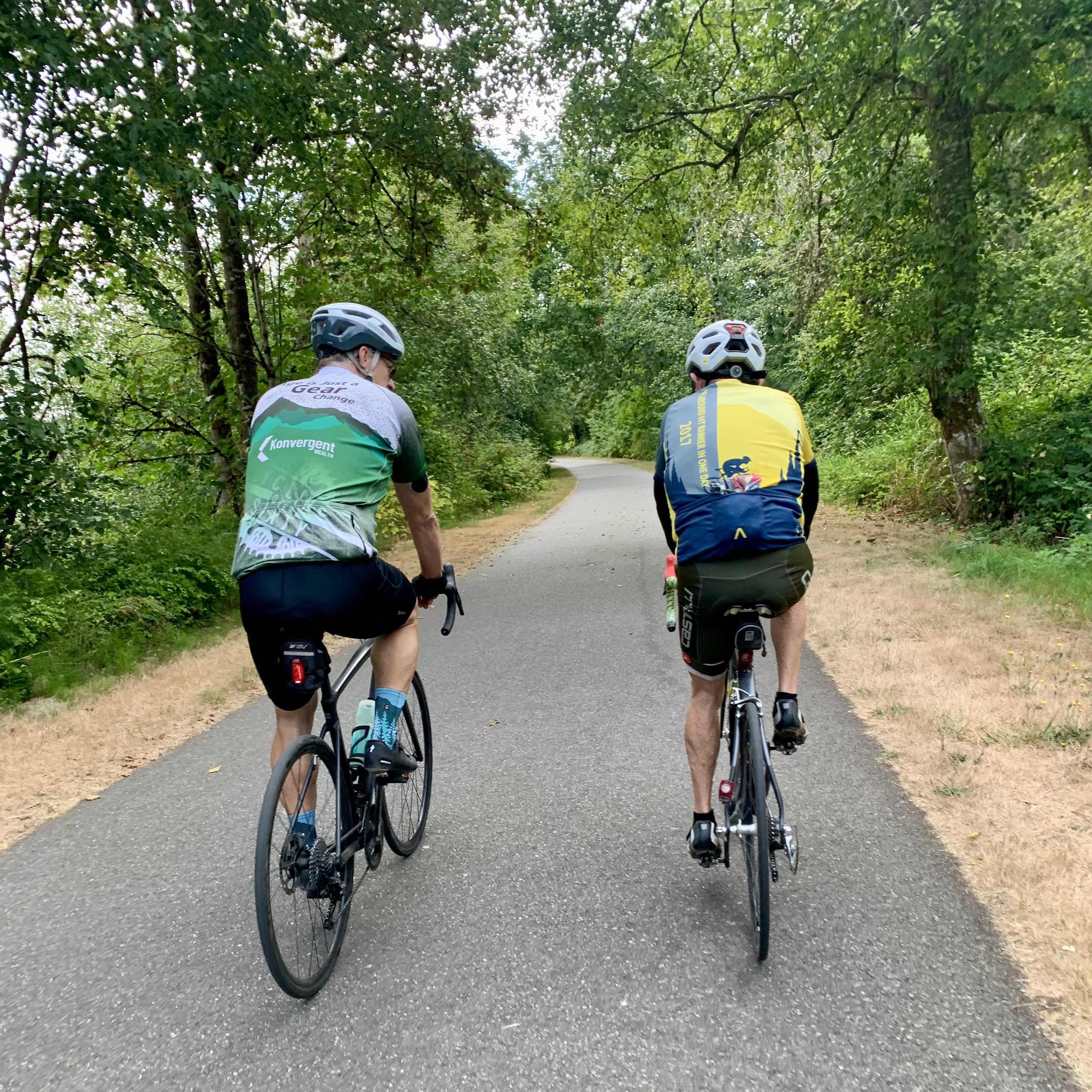
Research shows that people who live near bike trails and multi-use paths like the Foothills Trail get more exercise.
“Ninety percent of my riding for my health is on the Foothills Trail,” says Butler, 63. Without the trail, “I don’t believe I would have been able to stick with cycling when I started at 59 years old.”
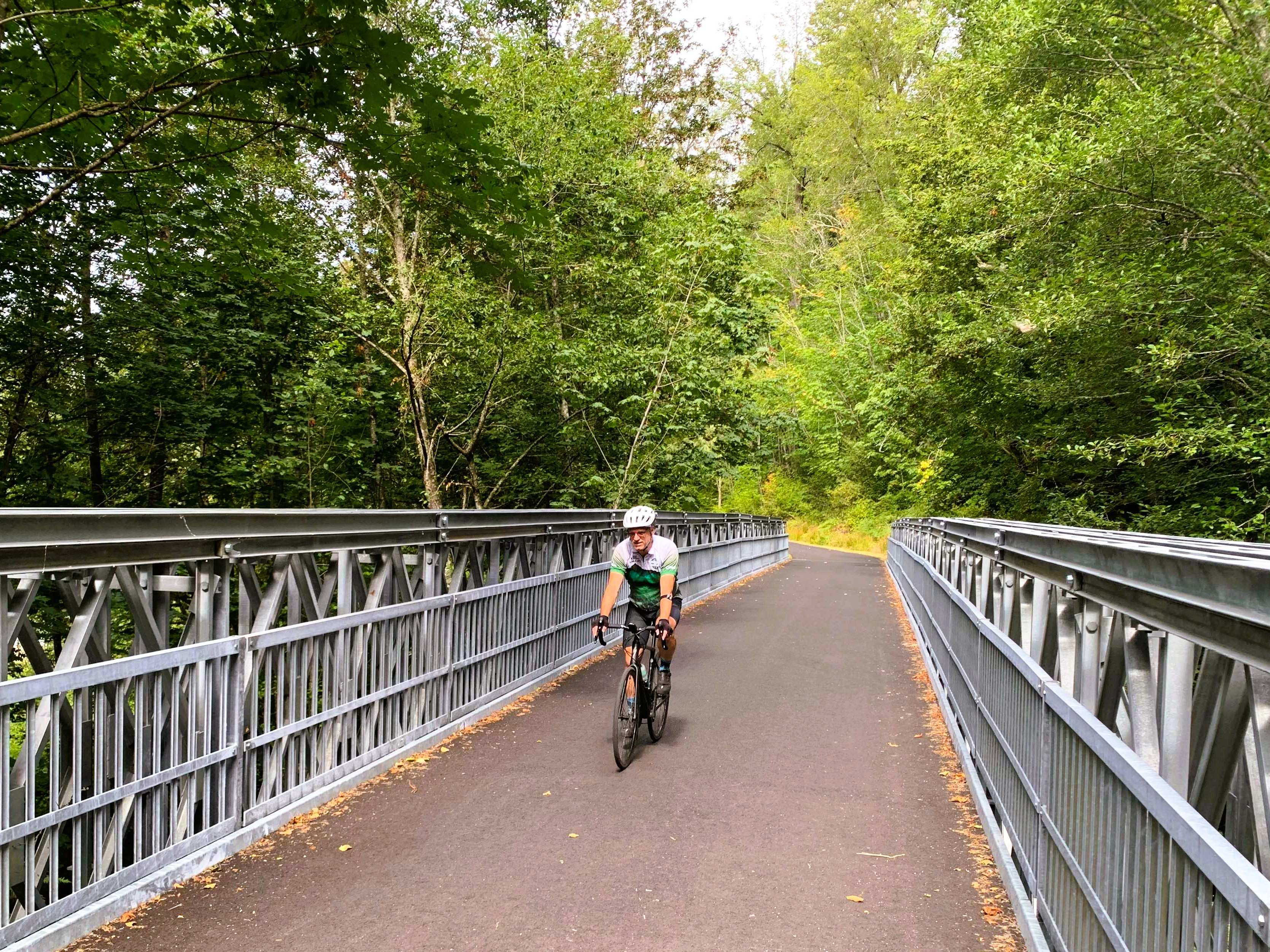
We pedaled over two new bridges on the Foothills Trail that show the importance of bike infrastructure to community wellbeing. The Spiketon Ditch Bridge closed in 2023 due to structural damage, causing “a major disruption for trail users, including me,” Butler says.
Thanks to fast action by Pierce County, a new $1.5 million bridge opened in September of 2025, restoring trail access.
The White River Bridge in Buckley opened in 2024, enabling trail users to reach Enumclaw. The new bridge was a game-changer for locals. When the nearby SR 410 highway bridge closed after being hit by a truck, forcing people driving between Enumclaw and Buckley to take a long detour, more people began walking and biking between the two towns because it was easier, faster, and more fun than driving.
If bicycling is medicine, then trails and safe bike infrastructure are essential for public health.
E-Bikes Enable More People to Bike for Health
During our ride, we saw many trail users on electric bikes.
“E-bikes are one of the biggest reasons the bike is the best delivery mechanism for exercise as medicine,” Butler says. “Intensity can be dialed down, making cycling genuinely fun and approachable, even for someone who’s been inactive for a long time.”
E-bikes also enable newer riders or older riders with less physical strength to keep up on group rides, removing a social barrier.
As the new community and government relations director for the Tacoma Washington Bicycle Club, Butler is working with medical professionals to get more of the estimated 60,000 inactive Pierce County residents over age 55 to begin biking and e-biking as medicine.
In addition to building strength, group cycling is an antidote to the epidemic of loneliness. The remedy is repeated social opportunities–exactly what regular group bike rides provide.
“Exercise is medicine, and the bicycle is one of the best delivery mechanisms for that medicine," Butler says.
We agree. So does the IRS. People can buy bikes with money from their Flexible Spending Accounts (FSA) and Health Savings Accounts (HSA) if they get a Letter of Medical Necessity from a healthcare provider. Learn more here.
Stay tuned for our next installment of Put Your Phone Down and Go Ride, when we will explore some Cascade Free Group Rides.
Share this post

